

The woman you were told not to trust
Why everything feels louder in the week you were taught to apologize for.

For years I thought there was something fundamentally wrong with me.
Every month, right on cue.
Suddenly everyone annoyed me.
My relationship seemed questionable.
My work felt pointless.
I’d mentally redecorate my entire life, bleed a few days later, and decide I’d been dramatic.
Rinse. Repeat.
So I did what a lot of women do.
I stopped trusting the woman who showed up before my period.
I apologized for her.
Blamed my hormones.
Rolled my eyes at myself before anyone else could.
Because everything felt louder that week. The resentment. The exhaustion. The unfairness. The questions I’d managed to keep quiet for the other three weeks of the month.
It took me an embarrassingly long time to wonder if I was diagnosing the wrong thing.
What if the loudness wasn’t the problem?
Maybe I’d been handed a story about what it means to be a woman who bleeds, and I’d mistaken that story for the truth.
Once that thought landed, I couldn’t stop asking a different question.
Who benefits when women learn to distrust themselves once a month?
Your body files a complaint
That ‘PMS’ week comes with a story attached, and the story is always about you.
Your hormones. Your mood. Your failure to cope with life.
You get handed it young. You carry it so long it stops sounding like a story and starts sounding like the truth about yourself.
So you start warning people.
Sorry, I’m premenstrual, or worse ‘hormonal’. You say it lightly, like a joke, and you hand them the excuse before they can reach for it themselves.
Then you run the audit on yourself. Too much coffee. Not enough sleep. Should have gone to bed earlier.
It was never you. It was never quite your hormones either. The woman who shows up that week is not a stranger and she is not unreliable. She’s the one still holding the receipts.
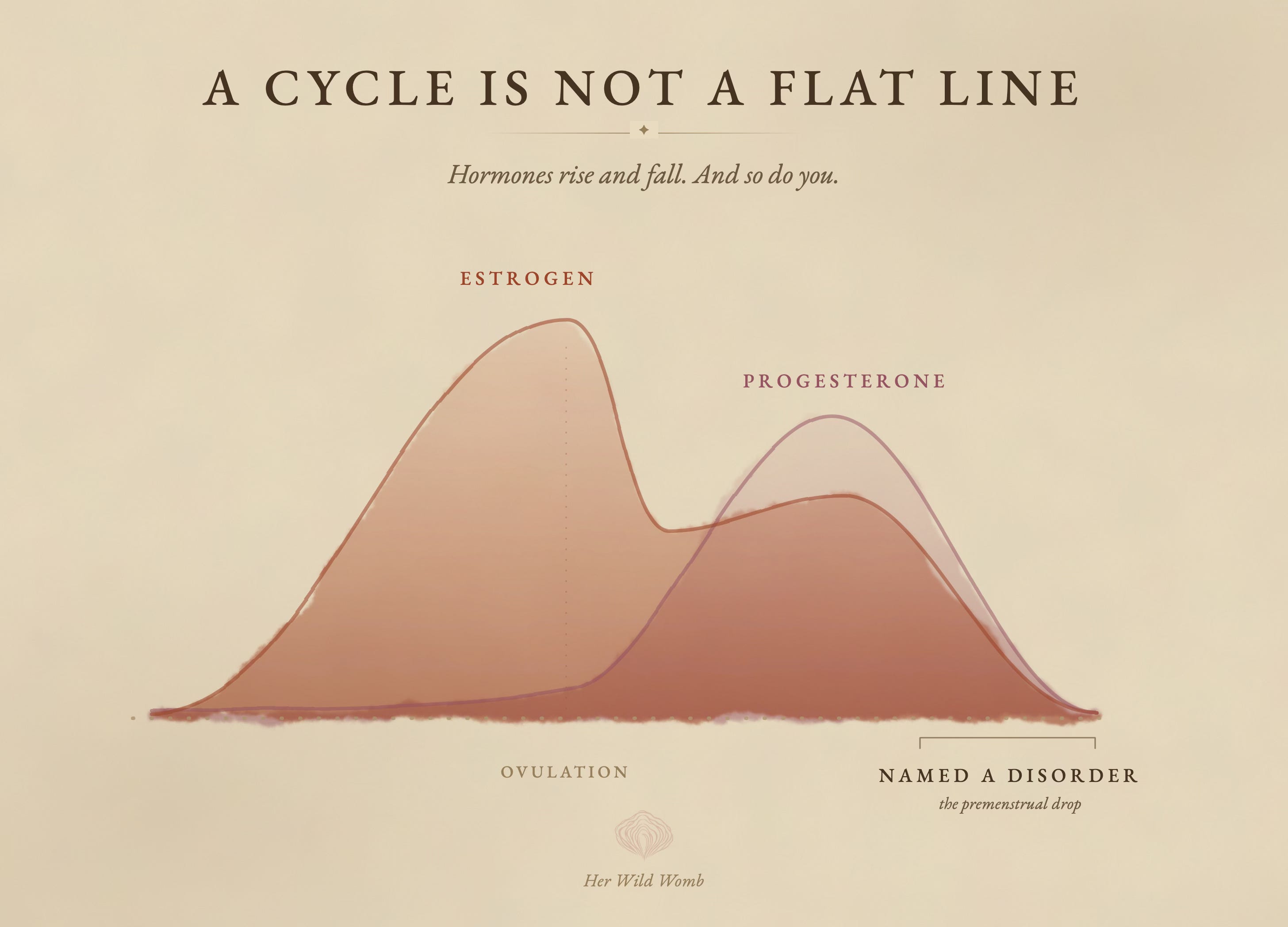
What’s closer to the truth: the week before you bleed, your body files a complaint. A formal one, stamped and dated, cc’d to your whole nervous system.
And of course she does, because look at the life she’s filing it against. A world that runs on one flat, steady, unchanging setting, all month, every month, and calls that normal.
A body that rises and falls and sheds and rebuilds, and gets called a problem for it. She complains, and she complains loudest in the week she has the least buffer left to be polite about it.
I spent years losing that paperwork. I grew up in a culture where pain was inconvenient, something to be silenced quickly and quietly. When the body talks, you find the thing that makes her stop. I learned that young, in my own home, and later, when I swore off pills, I found a classier version of the same trick. It was called busyness. A full calendar and an empty tank, and I called it a life.
She kept filing anyway. Same complaint, every month, loudest before I bled. Which, looking back, is almost funny.
But not really.
PMS is often reduced to a hormonal problem. And the hormones are real. They matter. But hormones are only the envelope. The letter inside is what you deserve to know.
Because once you open that letter, you discover something even weirder.
It doesn’t say just one thing..
It was never one thing
It was never one thing, because a complaint takes the shape of whatever it’s complaining about.
Maybe yours isn’t fire at all. Maybe you drift. Maybe you cry in the cereal aisle and couldn’t tell a judge why. Maybe it’s dread with no return address, or your skin feels two sizes too small, or you’re just, suddenly, very done being nice. And then, because we are exquisitely trained, you apologize for filing at all.
You tell yourself you should handle this better, that you’re overreacting, and you fix your face before anyone sees.
One word gets to cover every one of those weeks. Premenstrual syndrome, standing in for more than a hundred and fifty documented symptoms.1
Rage, insomnia, weeping, brain fog, sore breasts, and a homicidal intolerance for the sound of someone chewing. Yes, that last one is me. Stay away from me while eating, please.
But look at the noun that was chosen for all of this. Syndrome. A disorder. Someone took a reasonable complaint about an unreasonable life and filed it under illness.
There’s one study I can’t stop thinking about. Four hundred and two women, measured with three official rulers. By the World Health Organization’s criteria, 80% of them had PMS. By the American gynaecologists’, 13%. By the psychiatric manual, 5%.2
The “disorder” depends entirely on whose ruler walks into the room.
Name me one other diagnosis that swings from four-in-five to one-in-twenty on the same woman and keeps its job?! When a category is that slippery, you stop asking what’s wrong with the women, and you start asking what the category is for.
The psychologist Carol Tavris had a theory about that, one that has aged like fine wine and rotten policy. PMS, she said, became a permission slip. The one week a month a woman was allowed to be furious, as long as we all agreed to call it a disorder instead of a fair review of her life.3
Angry because the load is genuinely unfair? Oh honey, that’s hormonal. Have you tried magnesium?
I FUCKING did try the magnesium. More than once, actually. (yes I am in my luteal phase right now, can you tell?)
There’s a lot of money to be made convincing you your perfectly rational response is a nutritional deficiency. Because you cannot supplement your way out of a complaint that happens to be true.
But before anyone could sell the cure, someone first had to define the condition.
But every diagnosis has an origin story. Someone, somewhere, decided this was a malfunction.
Let's meet him.
Somebody decided she couldn’t be trusted
Somebody made this. A complaint became a disorder because someone, somewhere, decided that was cheaper than changing the life. The three letters didn't fall out of the sky.
People wrote them down, and the first of them was a man.
1931, New York. The story goes gynecologist Robert T. Frank gave premenstrual suffering its first official medical name, "premenstrual tension." He wrongly blamed them on an excess of estrogen, a theory that shaped decades of research and misunderstanding.4 It was like the first brick in a house women would spend the next century living inside.
We now know PMS isn’t caused by too much estrogen, but by the brain’s sensitivity to normal hormonal shifts.
I read his paper on my phone one evening and had to put it down for a minute. A man I’d never heard of had named what I’d carried for years, and it had never once crossed my mind to ask who got to name it.
He didn't discover these weeks, of course. Women had lived them in their own bodies long before he arrived. What Frank added was the diagnosis. And tellingly, much of the medical conversation that followed focused not on what women were experiencing, but on how those symptoms disrupted their ability to function, work, and fulfil the roles expected of them.
And underneath all of it sits the assumption that runs the story: the male body as the factory setting. Steady, flat, the same on day one as on the fifteenth. Imagine building every doorway in the world for one height, then calling everyone else misshapen when they keep bumping their head.
But you are not the problem.
You’ve been measured against a body you were never meant to be, then handed the bill for not fitting it. Twenty years later, in 1953, two British doctors gave us the three letters we still use: PMS.
Raymond Greene and Katharina Dalton.
I like this part because it complicates the story. Dalton spent her career arguing that women's suffering before their periods was real, at a time when many doctors dismissed it. She was, in a way, trying to help.
She changed the label on the drawer, but the drawer stayed the same. In giving these experiences a medical name, she also helped cement the idea that this phase of the cycle was something to diagnose, manage, and eventually fix. Frank had blamed estrogen. Dalton blamed progesterone.
Later evidence failed to support either as the whole explanation. They kept looking in the blood. The volume knob was in the brain.5
One decade it’s estrogen. The next it’s progesterone. The theory changes, but the spotlight stays in the same place. On her body, rarely on the life around it. Even a woman fighting for us was working inside a system that mostly knew how to ask one question: Which hormone is responsible? Not: What is this body responding to?
And once a condition exists, someone eventually finds a way to sell the treatment. The year 2000. Prozac is about to lose its patent, which for a drug company is roughly a bereavement. So the maker takes the identical molecule, drops it in a prettier capsule, renames it Sarafem, and re-sells it for premenstrual dysphoric disorder.6
Same drug, new colour, fresh patent, fresh diagnosis to pin it to.
They made it pink.
And under the prescriptions, a glittering shelf. The supplement industry sells that week calm-in-a-bottle by the billion, and many supplements, especially in countries like the US, reach the market without ever having to prove they work.7
The complaint never changed. Only the filing cabinet did. This is what happens when distress gets privatized. The load never appears on the chart. Not the second shift, not the unpaid hours, not being the one who notices everything before anyone else does.
Only she appears on the chart. She is the only thing anyone thinks to fix. So who benefits when women learn to distrust themselves once a month?
Certainly not women.
A world built around uninterrupted productivity benefits. A medical system that was trained to treat the individual before questioning the conditions she lives in benefits. Industries selling solutions to women convinced they’re the problem benefit.
The cost lands somewhere else.
It lands in the woman who apologizes before she’s even spoken.
What if this wasn’t the only way humans have ever understood these weeks?
Before it was a disorder, it was weather
Before anyone called it a disorder, older traditions called it weather. And weather, unlike a disorder, is something a life can be built around.
Ayurveda is one of those traditions. I’ll be careful here, because Ayurveda gets flattened too, usually by someone selling ashwagandha with a moon printed on the tub. Classical Ayurveda has no word for PMS. None. It reads the cycle as moving weather, and the days before your blood as a turning point, one season handing off to the next.8
Those texts mapped that handover thousands of years before anyone said the words luteal phase.
And underneath sits a line from one of its founding texts that is franker than most modern medicine: no fixed name can hold every body, so you treat the woman in front of you, not the category she landed in.
A map is useful until you mistake it for the country.
The version you’ll meet online, three neat little PMS types, is a modern gloss on a map far older and humbler. Qualities constantly moving through different bodies, in different amounts, in different months.
Your fire is not my fire. Your fire this month is not even your fire last month. It’s a forecast. A life you can plan around, the moment you decide your body is worth planning around
In Europe, where my own bloodline runs, we had this knowledge once. Women with the herbs, the hands, and a plain, unbothered authority over a body in its seasons. They were weather readers. Then they were pushed out, barred from the universities, their medicine re-credited to men or laughed off as old wives’ tales.
Old wives. As if “old” meant obsolete instead of experienced. The same world that never learned to listen to a woman's body made very sure to remove the women who could.
By the time any of that might have reached my grandmother, it hadn’t been passed hand to hand in five or six generations.
That's why I instinctively first was drawn to Ayurveda. Because it had preserved a conversation with the body that my own continent had abandoned.
Which is its own irony. Colonialism first called Indigenous medicine superstition, only to patent parts of it and sell them back decades later.
Many cultures stopped asking what the body was trying to say and started asking how to make it quiet..
—
This letter is free. If it’s useful to you, consider subscribing or buy me a (decaf) coffee. Both keep the next one coming. 💌
The bill comes due before you bleed
This is the science and the magic that probably nobody ever sat you down and explained. If someone did, consider yourself lucky. Finally learning it changed so much for me, and it's where 'everything feels louder' stops being a metaphor and becomes something you can measure
The luteal phase is often the moment accumulated load becomes most visible.
There’s a name for the bill. Allostatic load. Your body is built to adapt. A stressful week, a sleepless night, a deadline, grief, an infection. It adjusts, spends a little energy, then recovers. That's healthy
Allostatic load is what happens when the adapting never really stops. Every extra burst of cortisol, every night of poor sleep, every emotion you swallow, every time you push past your limits instead of recovering, your body keeps track.
In short: it’s the cumulative wear and tear on the body's organs and tissues from chronic, long-term stress
That’s the most honest reason a weekend away doesn’t clear it. A weekend is a payment, and the debt is years deep. You cannot spa your way out of a decade of overriding yourself to fit a world that never met you halfway, and somewhere in you, you already knew that.
I want to say this plainly:
Your hormones are probably not the problem.
Researchers have gone looking for the difference in the hormones themselves, and mostly they cannot find it. The levels in women with PMS symptoms look much like the levels in women who barely clock their cycle.9
Right before your period, estrogen and progesterone naturally fall. That’s part of the menstrual cycle. It’s gets interesting why the same drop barely registers in one woman and knocks another sideway
What differs is how loudly your body hears the change, on top of all you’re already carrying. Think of the month as high tide. Most of the time, the water covers what’s lying on the seabed.
Then your hormones pull the tide back. Which sounds much prettier than it feels. They reveal the rocks thats are already there. That’s why the complaint arrives before you bleed. For a few days each month, the water is low enough to see what was always there.
Which raises the obvious question. If the hormones aren’t that much different..then what is?
Where the calm goes
After ovulation, your body prepares for the possibility of pregnancy. Whether or not a child comes, your body spends two weeks preparing to welcome life. Imagine the generosity of that.
The empty follicle that released the egg transforms into a tiny temporary gland called the corpus luteum and begins making progesterone. Its job is to prepare your womb for new life. It stabilizes the lining of your uterus and changes how your brain processes stress.
Some of that progesterone is turned into allo-pregnanolone, a powerful neurosteroid that interacts directly with your brain’s calming GABA receptors.
During these two weeks, your body is brewing a powerful shift in your nervous system.
Picture a weighted blanket, the kind that alters how your nervous system perceives the world. For two weeks after ovulation, your body lays one over you. For many women, that blanket is a soothing, steadying comfort. Then, right before your period, she abruptly lifts it off. For those women, it’s a gentle uncovering: a return to baseline.
But for others, the blanket itself is a mismatch. If your brain is highly sensitive to hormone shifts, the arrival of that blanket doesn’t calm you down; it makes you feel trapped, anxious, and deeply unsettled. And when she finally lifts it off right before your period, your nervous system gasps for air, experiencing a sudden, cold withdrawal.10
Serotonin dips in that back half too, like someone reached over and turned the brightness down on the world. Nothing happened. Everything just looks darker.
Your stress system also becomes more reactive in the second half of your cycle. Picture a smoke alarm getting more sensitive by the day, so that the same burnt toast that did nothing last week now sets the house screaming, right as your calm is thinning out.11
And that’s on a good month. Because chronic stress changes the house itself.
Imagine living in a home that’s been under strain for years. The wiring is old. The insulation is thin. The smoke alarm goes off when you make toast. One by one, the lights start flickering. Then whole rooms go dark. The house is trying to keep the essentials running.12
Chronic stress reaches up into your brain and begins turning the cycle down. Ovulation gets weaker, or skips town entirely, and the progesterone that should have become your calm never fully arrives.
Read that again, slowly. Your body is rerouting power to keep you alive. She’s responding, exactly as designed, to a life she was never designed for.
Then there is inflammation. Women with PMS tend to run higher markers of low-grade inflammation, the same background fire that stress and short sleep and a hard life keep feeding.13
Food feeds that fire, or it doesn’t. Women eating the most inflammatory diets report the most severe premenstrual weeks. High sugar, high salt, also caffeine, alcohol, the food or drinks you might reach for when you’re already too tired to cook.
Which is exactly when you reach for it. The week your body has the least buffer is the week the sugar calls loudest, and the sugar makes the next month a little worse.
That’s a loop.
And here’s where I have to be careful, because this is the point where wellness usually starts selling. There is no universal anti-inflammatory diet. Identical twins eating identical meals grow different guts and thrive on different food. Kale can genuinely hurt the wrong belly.
Ayurveda would never hand every woman the same meal plan. The medicine changes with the pattern. One principle, though, holds true across traditions: anti-inflammatory foods that stop feeding the fire.
Your hormones move the tide. Your brain decides how hard the drop hits. Your history and your load decide what’s lying on the floor of it. And your culture decides whether you’re even allowed to look.
That's where the loudness comes from. Ordinary hormones, arriving in a nervous system with the volume already turned up by everything it's been carrying. A sensitivity answers to sleep, to load, to food, to how much of your life you're allowed to say out loud
So what do you actually do with that information?
What listening actually looks like
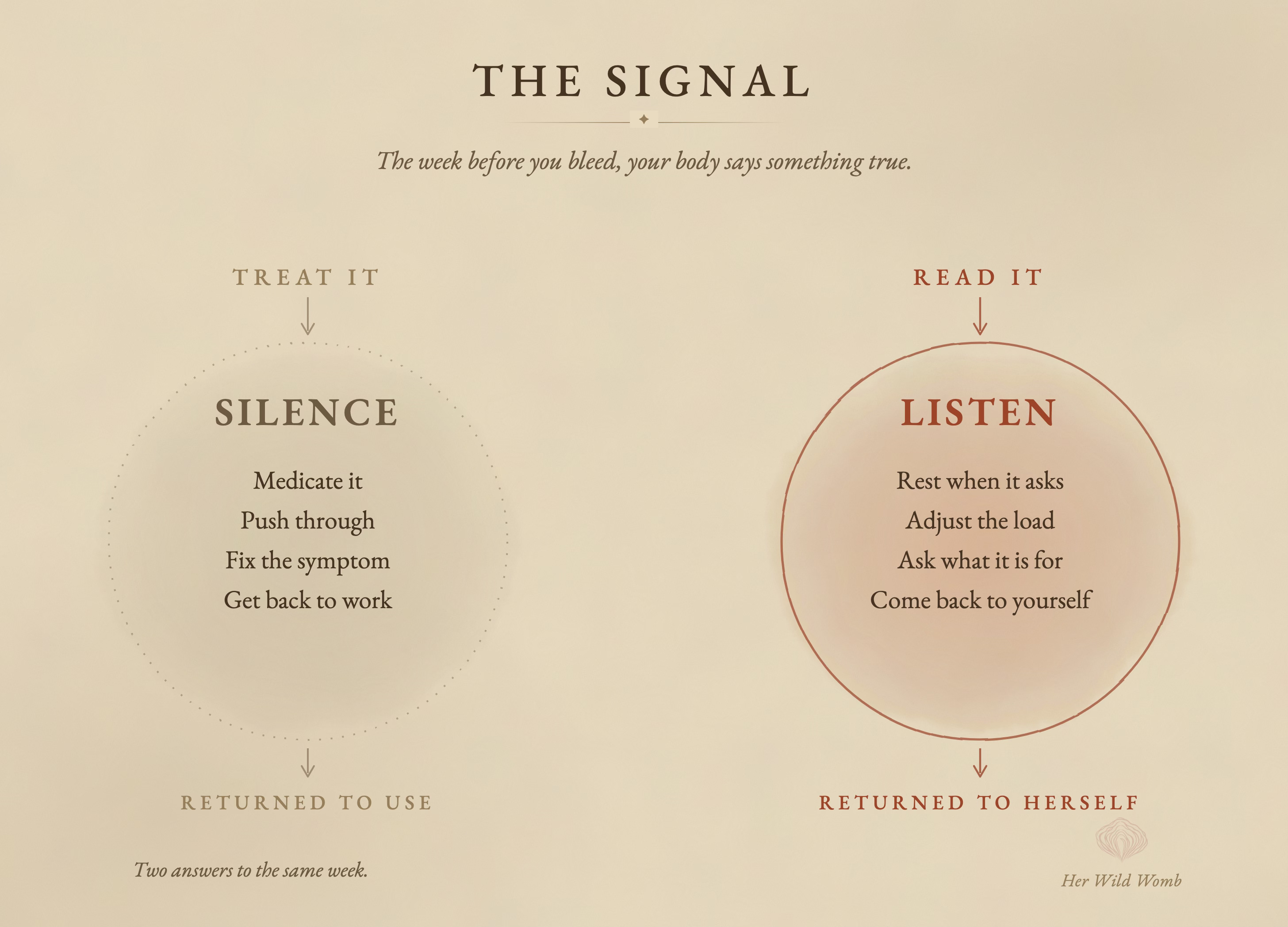
Alright. Enough theory. Listening is answering the complaint instead of silencing it.
The body never speaks the loudest first. She begins with whispers. Then dreams. Then fatigue. Then tears. Then rage. By the time she is shouting, she has already tried every gentler language she knows.
Your cycle is a monthly report on your life. Sleep, load, food, nervous system. Clinicians who get it now call it your fifth vital sign, right there with your pulse and your blood pressure.14
A lot of women have a hard week, and that makes it common. But common is not the same as normal, and it is nowhere near your destiny. A complaint that gets heard, month after month, gets quieter over time.
You finally started building a life with room for her.
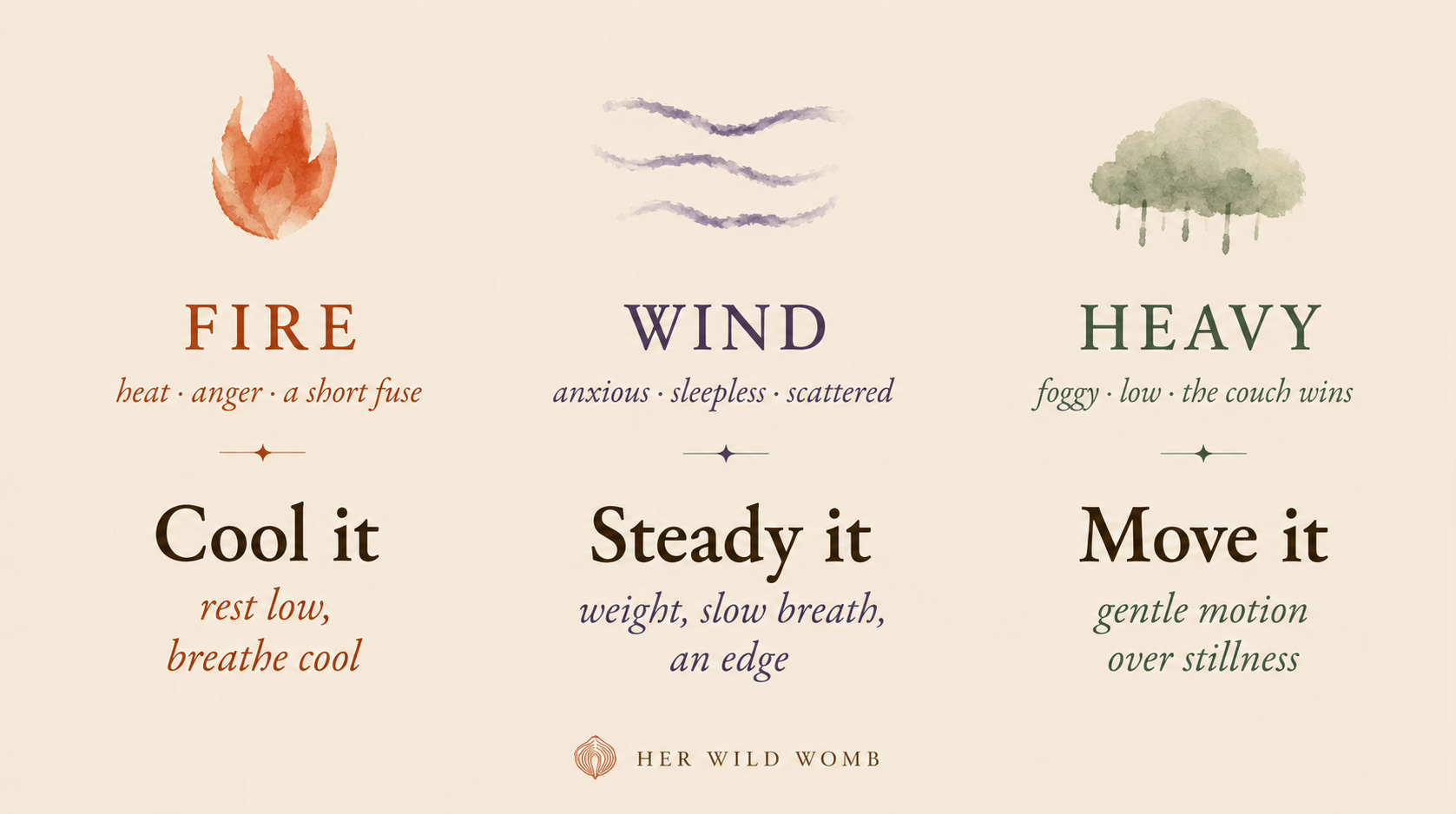
Ayurveda asks one question first. Which way is your week running? Read it like weather, then dress for it. Most of us are a blend, and the blend moves, so read all three and use the one that sounds like right now.
Every practice below is talking to the same place the loudness starts: your nervous system, through the body she lives in
Also at the end of this post, I will have a few more tips how to prepare for this week.
If your week runs to fire. Pitta, Ayurveda calls it. You'll probably recognize yourself if your first instinct is to snap, criticize, or feel suddenly intolerant of everything and everyone.
Rage, heat, breakouts, sore breasts, a fuse getting shorter by the hour. Don’t feed it. Cool it. Lie on your back, knees wide, soles of the feet together, and let the floor take all of it. Then breathe cool: curl your tongue into a straw, sip the air in, out through the nose, seven rounds. It’s the oldest trick I know for setting rage down without swallowing it.
Cool the fuel too. Cucumber, coconut water, ripe fruit, and a gentler hand with the third coffee that feels load-bearing. It isn’t. Shatavari or aloe, if you keep herbs.
If your week runs to wind. Vata, in Ayurveda’s language. You'll probably recognize yourself if your mind won't stop spinning and even small things suddenly feel overwhelming.
Anxiety, insomnia, scattered, bloated, a mood that turns with the light. Same reclined shape, then pile on weight. Socks, a blanket over the hips, something heavy across the belly so your body can feel her own borders. Slow the breath right down, in and out through the nose, long and even. Eat warm, cooked, a little heavier than feels virtuous. An actual bowl of soup, with fat in it, sitting down like a person.
Warm sesame oil worked into the belly and low back beats any app on your phone. Ashwagandha or shatavari, if you keep herbs.
If your week runs to heavy. Kapha, the tradition names this one. You'll probably recognize yourself if all you want to do is disappear under a blanket and the world feels heavy, slow, and muted.
Water, weight, fog, flat mood, a couch with its own gravity, and sugar calling your name. Here the medicine is motion. Open your chest over a rolled blanket, then get up and move. A fast walk, the stairs, anything that shifts the blood.
Lighten the food, warm water all day, ginger, and a firmer no to the sugar the cravings beg for. The cravings are right that you need fuel. They’re just wrong about the kind. Turmeric and ginger, if you keep herbs.
A quick, serious word on the herbs. A plant works on your body, and your nervous system, as surely as anything from a pharmacy. One at a time. Start low. Watch how you answer. Pregnant, on medication, or unsure? Ask someone who actually knows plants and bodies first.
The alchemists had a word for the stage everyone wants to skip. Nigredo, the blackening. The moment when the old shape has to dissolve into something dark and formless before anything new can be made. The world taught you to fear this step.
Your premenstrual week is a nigredo. The tide goes out, the lining loosens, and everything you kept polished goes dark and shapeless for a few days. Every month the veil thins.
What was hidden can no longer stay hidden. That is the work. Dissolve, then reform, the old texts said. You’ve been doing the dissolving every month, and calling it a disorder.
Bracing against it is what makes it hurt.
Which raises a fair question. How do you know the complaint you think you’re hearing is actually yours?
Turn it into evidence
Sooner or later, someone across a desk will tell you it’s just PMS, that it’s normal, that it’s probably stress, and part of you will believe them. That, love, is the moment the gaslighting completes itself.
You get dismissed AND when you agree with them.
The psychologist Jennifer Mullan spent a career arguing that therapy was never neutral, and that what gets diagnosed as personal pathology is often a political condition wearing a private name. When a society won't hold up an honest mirror, you read yourself in the cracked one you were handed.
You get a label, and slowly, without ever deciding to, you start filing the complaint against yourself. And here’s the part that should make you angry, and this time your anger has an address.
In many cases, your doctor simply wasn’t taught much about the hormonal life of your body. The curriculum decided, generations ago, that this was a niche.
One survey of U.S. medical schools found that only 58% included formal teaching on PMS and PMDD in their obstetrics and gynecology curriculum. In other words, around four in ten medical schools weren’t formally teaching future doctors about one of the most common conditions affecting women of reproductive age.15
The biggest reason given was lack of time.

Ironically, daily symptom tracking is the recommended way to diagnose, yet one study found that only 11.5% of physicians routinely used the recommended two-month daily tracking before making the diagnosis.16
The body has the data. Too often, nobody was taught how to read it..
How do you track yours? I’m curious what actually worked for you.
So when someone across the desk says, “That’s just how it is for women,” it sadly may be the sound of their training running out, wearing an answer as a costume. Clever people, guessing with excellent posture, inside a system that gave them a couple of minutes per patient and a thin chapter, then expected an answer anyway.
And I want to name the older thing underneath it too, because it has a name:
Misogyny.
feelings of hating women, or the belief that men are much better than women - Cambridge dictionary.
This wild idea women’s pain is somehow always emotional until proven otherwise. It’s why women wait around seven years for an endometriosis diagnosis while their pain gets filed as dramatic.17
It’s why normal is the most expensive word in this entire conversation. Normal is what a world says when it has decided your suffering is the cost of doing business inside it.
What has been done to women in the name of science is violence. Our bodies were called deficient by men who had never lived in one. Our pain was called emotional until proven otherwise, and then called emotional again. We were kept out of the trials, then dosed with whatever the trials on men decided was safe. And every time the story turned out to be wrong, the correction landed on us and never on the people who wrote it.
It did not stop when the language got politer. It just learned to sound reasonable. Nine in ten doctors still will not spend two months measuring a week that takes a quarter of your life before telling you it’s normal.
Not knowing is somewhat forgivable. Not looking is not
So don’t walk into that room with just a story.
Walk in with evidence.
Track your cycle.
Not forever per se, but for at least three or four full cycles. Or a full year moving through all seasons too. How your body and your mood actually felt, day by day. Because your memory is a terrible witness here, and after the fact she pins everything on the premenstrual week.
Use a proper tracker, the notes app, a notebook by the bed. It doesn’t matter. You’re hunting one thing: do your hard days cluster in the back half of your cycle and lift when you bleed? Patterns matter far more than isolated bad days. The full list of what to note is at the bottom of this letter.18
And please, forget day fourteen. Ovulation moves. The back half of your cycle can run anywhere from eleven to seventeen days. Your window is yours to find, not a number off a leaflet.
That pattern, or the lack of it, is the single most powerful proof you can carry into your own life.
If you take this into a doctor’s office, and sometimes you absolutely should:
1. Bring your pattern. Track your symptoms for at least a couple of cycles. The pattern matters more than the symptom.
2. Don’t stop at “It’s PMS.” Ask, “What’s driving it?” PMS is a description. The next question is why your body is struggling.
3. Ask what needs to be ruled out. PMDD, endometriosis, adenomyosis, thyroid disease, iron deficiency, perimenopause, or something else.
4. Ask what they think your body is responding to. Trauma. Chronic stress. Inflammation. Poor ovulation. A nutrient deficiency. Perimenopause. Something else? A diagnosis should open the conversation, not close it. Keep asking why.
5. If you're told, "That's normal for women," ask, "Normal by whose standard? "What have you ruled out before calling it normal?"
6. If you still don’t feel heard, get another opinion. Good medicine stays curious. It doesn’t stop asking questions just because a label fits. And your GP isn’t the only door. An Ayurvedic practitioner. A naturopath. A gynaecologist, an endocrinologist, a women’s health physio, a dietitian.
Different training, different questions. Don’t stop at the first door.
There is a violence in treating symptoms while refusing to ask what they are responding to. The body keeps speaking because the conversation never actually began.
And while you’re waiting for the system to catch up, there is a great deal you can do for her yourself.
When it is more than hard
For a lot of women, this week is hard. For some, it’s flooring. Every cycle, lifting only when the blood finally comes. That has a name. Premenstrual dysphoric disorder, PMDD. It’s real, it’s its own condition, and it comes from a brain unusually sensitive to a completely ordinary hormonal drop.
In research, women with PMDD can't be told apart from women who barely clock their cycle. Not by their hormone levels. For the milder end, the picture is less tidy, and researchers still argue about it. But the direction of travel is the same.
Your body is not producing the wrong hormones.
Researchers switched off ovulation in women with PMDD, and the symptoms vanished. Then they added back perfectly normal amounts of estrogen and progesterone, and it all came roaring back.
Women without PMDD felt nothing either way.19
So what is it, then?
It seems to be a receiving problem.
Researchers took white blood cells from women with PMDD and grew them in a dish. No stress, no deadlines, no life attached. Then they added the same hormones every woman makes, and the cells answered differently. A whole gene complex, the one that manages how a cell responds to what’s around it, was running higher than in the other women.
The message was identical. The receiver was not.
Even here, the complaint is real and your body is not lying. She’s filing at a volume that needs a professional in the room. It reaches a few in every hundred women, and if that’s you, please don’t try to breathe your way through it alone.
PMDD isn’t my area of expertise, and I want to be honest about that. If you recognize yourself here, please find a clinician with experience treating PMDD.
If you’ve found a practitioner, book, researcher, or resource that genuinely helped you, leave it in the comments. I’d love to learn too, and I know other women reading this will benefit from it.
Some things need a professional. Knowing when to reach for one means you’re listening well.
And after all that science, we’re left with something surprisingly simple.
Meet her again
Since I started making room for the woman I actually am instead of the one I thought I had to be, something unexpected happened.
That old premenstrual rage became quieter once I stopped asking my body to carry a life that kept asking her to disappear.
It took me years to understand that those weeks were rarely about whatever had happened that afternoon. They belonged to everything I’d adapted to long before that. Every truth I’d swallowed. Every boundary I’d talked myself out of. Every time I ignored my own rhythm to keep up with a world that never expected me to have one.
Research now gives us language for part of that story. A nervous system carrying years of accumulated load becomes more sensitive to the ordinary hormonal shifts before a period. The hormones move. The brain hears them differently.
That’s why everything feels louder.
She has less energy left to keep quiet.
That’s why we’ve spent so long calling it a disorder.
It’s easier to distrust the messenger than to change the life she’s describing.
The clinic may call it a syndrome.
I still think it’s a complaint. And the woman filing it is the one you were told not to trust. She’s simply the one who stopped being able to pretend.
A complaint carries an invitation.
To stop outsourcing the interpretation of your body.
To become the woman who can read her.
Because once you learn her language, everything that once felt like chaos starts to become information.
Information becomes understanding.
Understanding becomes trust.
And trust is how you stop siding with the world against yourself.
—
Thank you for reading. For being here. For getting all the way down here with me. With Her Wild Womb is my mission to restore women's authority over the interpretation of their own bodies.
💗 I have exciting news! 💗
Listening to your body doesn’t mean suffering in silence. Sometimes what she’s telling you is that it’s time to get help.
My website goes live soon, with all my offerings, and this space hears first. And it’s finally here. After months of dreaming, creating, and listening, the monthly womb circle is open. A place to slow down, be witnessed, and learn the language of your own body alongside other women.
The next Womb Circle is all about tending your relationship with your cycle. Whether you (still) bleed or not, you live in cycles. Come reconnect with the wisdom of your body alongside other women.
Reserve your place here and I'd love to gift you 25% off. Use the code WELCOMESISTER when you book.

Wherever you are in your journey, I'd love to have you. Come and take your seat.
Or let this letter be enough for today.
With so much love,
Anouk
If this moved something in you, it would help this publication so much if you’d tap the heart 💗 and restack it. Every like sends it to one more woman who was taught her body was the problem. And if you’re not here yet:
A few more, if this one spoke to you


How to support your body before your period
I promised you practical, so here it is.
The week before your period isn’t the moment to rely on willpower. So let’s make it easier.
A few things help almost everyone.
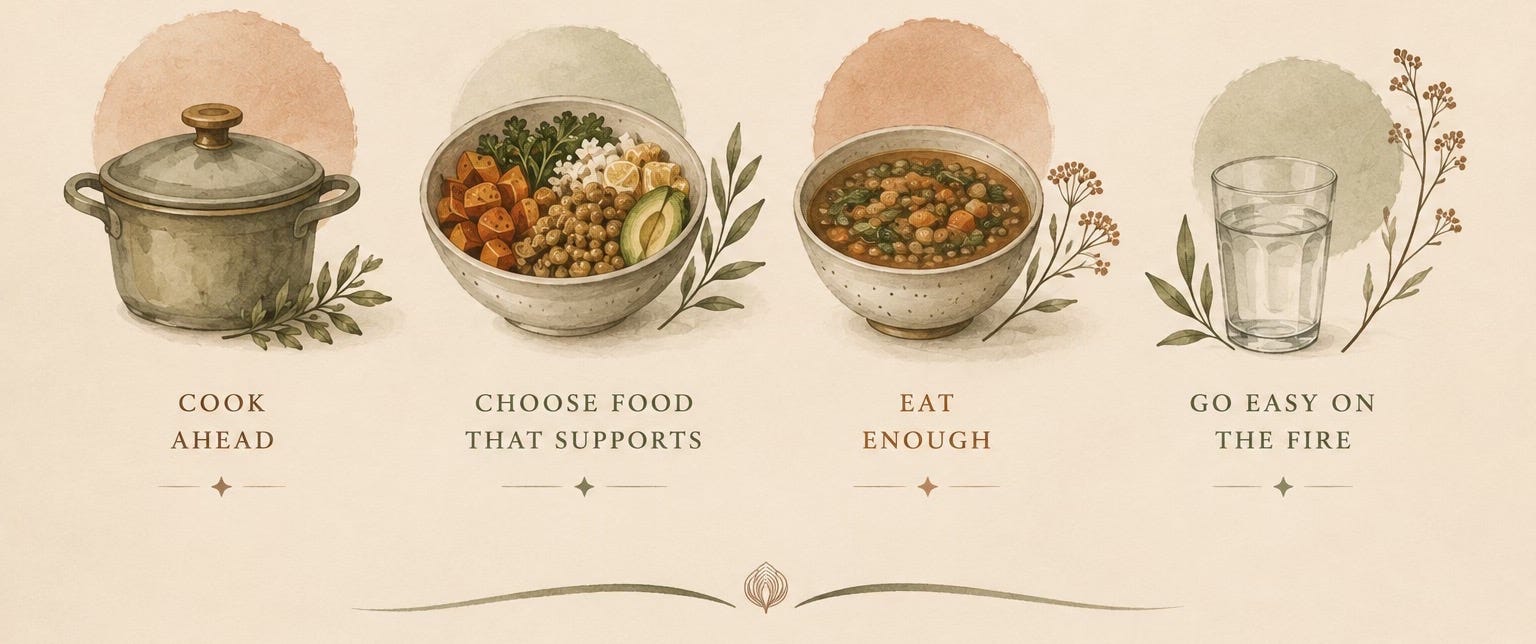
Cook before you need it. The days you most need nourishing food are often the days you have the least energy to make it. Prepare something earlier in your cycle, when you have more capacity. Soup, dal, a stew, roasted vegetables. Future you will be grateful.
Choose food that feels supportive, not punishing. A bowl of lentil soup. Salmon with roasted vegetables. Tofu or tempeh stir-fry. Chickpea curry. Greek yogurt with berries, or topped with walnuts and seeds. Simple, nourishing meals that provide protein, healthy fats, fibre, and plenty of colourful plants. Your body needs steady fuel, not another battle with your plate.
*Soy contains phytoestrogens, plant compounds that can interact with estrogen receptors. The research on how much is ideal is still evolving, so I prefer variety over relying on soy as a daily staple.
Eat enough. Your energy needs naturally increase in the second half of your cycle. Hunger is biology asking for healthy resources.
Go easy on the things that add fuel to the fire. For many women that means less (or no) alcohol, less ultra-processed food, and paying attention to how caffeine, sugar, and highly processed foods affect your body.
And then the part that isn’t food at all.
Before you reach for the off switch, sit somewhere quiet. One hand on your belly. Five slow breaths, each exhale a little longer than the inhale.
Then ask:
What are you trying to tell me?
What have I been putting up with that isn’t true anymore?
What needs me now, before you have to shout this loudly again next month?
The full list to track:
Mood
Flow
Sleep
Energy
Cravings
Digestion
Skin changes
Pain or cramps
Breast tenderness
Stressful life events
Headaches or migraines
First and last day of bleeding
Yes to all of this. I've been thinking much of this for years and years and years. And living it for decades, of course. Thank you for the research notes and references. Thank you ✨️
If the low-tide week is the accurate one, then the calm three weeks aren't our baseline. The politics isn't only in filing the complaint as a disorder; it's in which self got crowned the real one. If we reassign the baseline, PMS is the week the anesthetic wears off. Brilliant piece. 🌿